France legalized same-sex marriages with the right to adopt. Soon, I am sure, this will also be legalized in Estonia, regardless of loud opposition. The reason being simply that there really are no rational arguments against, and the whole question is just that of into that of traditions.
But what would you think of the argument that women should loose their right to vote, because it is untraditional in European Christian culture? Which actually is the case. So in effect, traditions describe the current state, but can not serve as justifications. As the society changes, so must customs be corrected, and for that reason, lets applaud France for the courage to cast aside unfair traditions and best of luck to Estonian lawmakers in doing the same. But what comes next?
This article was written in response to ignorant statements made by a local MP, claiming homosexuality to be a curable disease. The article was published in Estonian in Õhtuleht 06.04.2013.
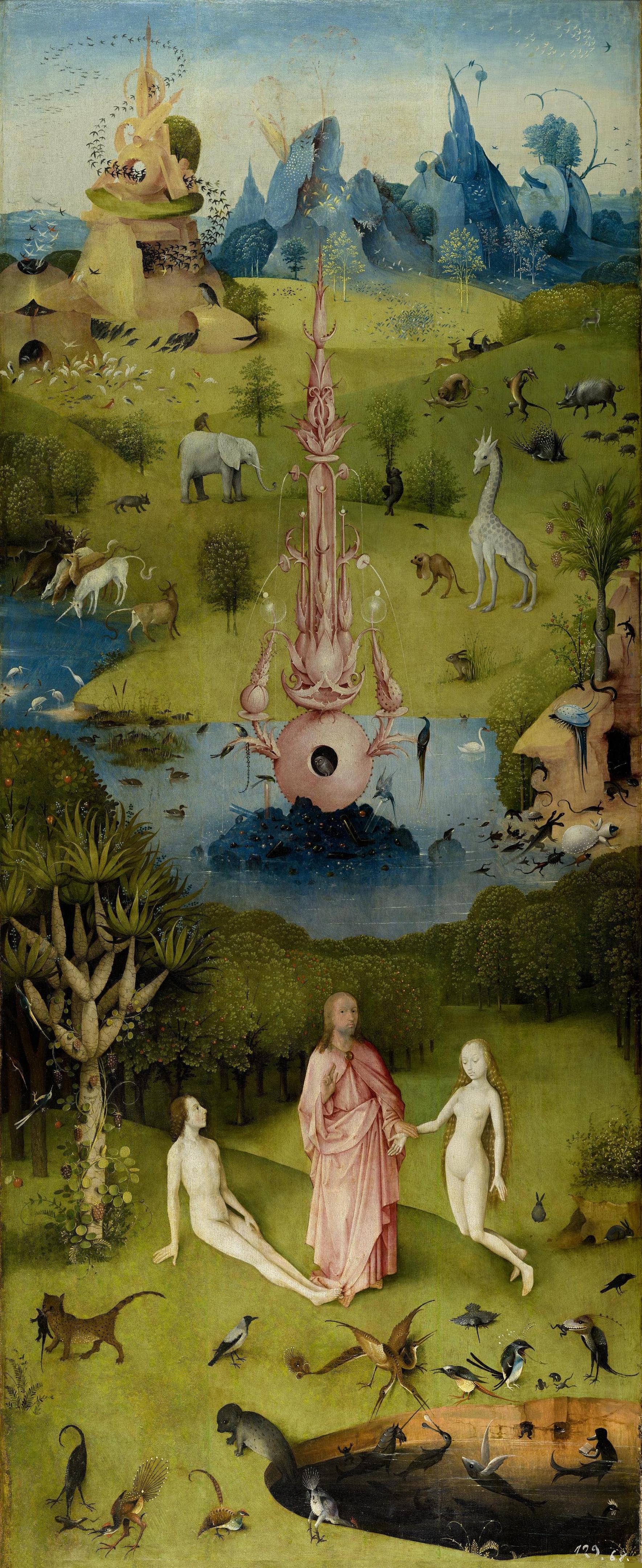
Hieronymus Bosch - The Garden of
Earthly Delights. Source: Wikimedia
in a kingdom far-far away, there… And this is where the stories part. In one, there are dragons, in another there are witches, and in the third one — kind fairies. Fairy-tales reflect beliefs about the world around us, and it is not possible to say that one of them is more precise, more correct or better in any way than another. The value and magic of fairy-tales comes exactly from there being many different ones, and there always being room for new ones, that will not replace any, but add to the magical-mystical world over the rainbow. And even though this claim is not entirely correct from the standpoint of folkloristics, let it illustrate the larger one — there are domains, where multitude of opinions is the valuable resource, and there is no truth as such, but each description, point of view gives new information. Wonderful information, that has given birth to the most beautiful and moving works of art, books, songs — the best achievements of human culture, that life would perhaps not even be worth living without.
For reasons completely unelated, I found myself having to translate a poem by an Estonian author, Gustav Suits, a prominent modernist from the first half of the 20th century. The original text is somewhat flexible with language, and thus the translation is also … somewhat.
A little while ago
I wrote a poem about chestnuts(*)
---
* horse-chestnuts — a fact I was reminded of again,
as rain carried away the last petals.
And that moment where the poem was born,
where there were real chestnuts,
was carried away the same.
But strangely enough this ceased to worry me,
as my gaze was drawn to a no-name hedge,
a generic shrub, third-party bush lining the courtyard,
covered in tiny blonde blossoms overnight.
The measure of man's suffering
Is the man
And I make you suffer
By breathing silence
Down your neck
You shiver in my absence
As I trace my fingers
Between your shoulderblades
Making you sigh and strech
Brushing my palm against your belly
Spreading my fingers
I feel the beat of our children
Unborn, unconcieved
My touch becomes firm as I
Grasp your thighs
There is a sharpness, a sweet pain
Under your breath
I slide down your slender legs
Down to the last toenail
Painted crimson red
The measure of man's suffering
Is the man
And I am yours
This one is from way-way back, but it has come round in a very wide gyre. I guess proletarian love never gets old.
I'd much rather talk about the Second Coming by W. B. Yeats, but I still lack the words to connect the dots. There definitely are points in time and thresholds in life, when the falcon and the falconer loose their shared language and no meta-narrative, no frame, no proverb holds true any more. Where do you turn then, is my question.
---
You worked late nights at the factory bar
You had a girlfriend named Margareth and a devilish laugh
When the lights went out, you led me upstairs
I took your clothes off in a company chair
The love we made was fervently rough
Your hands were coarse but your body was soft
And now that I know I am dreaming
I will ask you to dance anyhow
It is not about staying or leaving
Just this song and the things that are now
You got in your jeans, I wanted to know
If you had a choice, where would you go
There was dust in the air of the foreman's room
You want to be someone and want to be cool
Go to a college and hear the boys brag
Of the late nights out and the girls that they've had
This is all but the words have a meaning
And I know you will read very wrong
It is not about staying or leaving
It has been about us all along
Budapest has a strange way of getting under your skin. The very first time I visited the city, it was hot, humid and the air was thick with exhaust. The streets were full of litter and there was no room for plants or trees. I cannot say I did not like it, but the impression was not overwhelming.
Then I became to know her better, her shady groves, underpasses, the quiet of Buda, the rustle of Pest, the little shops where a girl wearing way too much makeup will cook you a lángos you would be wiser not to eat. Yet you are tipsy enough to brave it.
And I cannot remember exactly when I fell in love, just that one day I was missing her velvety nights, be they pierced by shouts on the street and the constant smell of urine. Nobody is perfect.
---
From the hills of Buda
To the sewers of Pest
When one day you see me again
Will I walk as I did then
Your streets my Budapest
Trams dash on the Körút(1)
I trace the footsteps of men
the Duna(2) has torn into you
the flow that has broken us two
I will follow her every bend
Will I float back to your island
Margit(3) - your breathing heart
Where once I bided my time
Will ever again I arrive
At Keleti pályaudvar(4)
---
1. Körút [IPA: køruːt] literally round street. Here referring to a main street circling from the Buda side to the Pest side.
2. Hungarian name for Danube
3. Refers to the Margaret island, a large park in the middle of Danube. The Hungarian name is Margit-sziget.
4. [keleti paːjaudvar] Eastern train station. One of the main stations in Budapest.
Take any of the great American minstrels like Simon and Garfunkel
Or Johnny Cash (lyrics by Rod McKuen)
Both these and other songs carry an immense sense of space, longing and belonging. They have always captivated me with the ease that they defy distances to find a human touch, a moment, an emotion. Thus far I was not sure what so moved me, but I think I have come to a better understanding.
One of the core pillars of American culture is tracing your roots, but not being bound by them. An enormous amount of people move because of their work, their family or other reasons. The small-talk society is partly a result of the constant need to create bonds quickly, settle in and assimilate to a certain extent.
A society where it is relatively easy to make connections is also a society where connections will be lost more often. At the heart of these songs is simply the matter of understanding - every arrival is a departure elsewhere.
In Europe, this dimension has not been visible to such an extent. But within the EU, supported by various academic, cultural and youth programmes, I believe that the Old World too is becoming a nation of heartbreak. As is fitting for a continent named after passion, love and abduction.
Here is one such story that happened to my closest friend. The text is dedicated to every Boeing, Airbus and ATR out there, departing from somewhere, arriving somewhere else.
Your bones Are made of composite alloy Light and strong My heavy, her fragile heart Cannot match the thrust Of your turbofans
How many times Have you brought us together How many times Have you torn us apart
Now bear me once more bear me home on your wings This once and no more
When words are all one has, one has to use them wisely.
Csönded vagyok is a very well known song, which is also very difficult to translate.
I have taken many artistic liberties with regards to the content, in order to keep the original metrics where possible. In theory, one should be able to sing the texts to the original tune. The singer however takes pauses that occasionally break words in other languages.
I like this version better, as it seems more honest, but the embedded one has better sound.
Magyar: Csönded vagyok
Most elmondom, mid vagyok, mid nem neked.
Vártál ha magadról szép éneket,
dícsérő éneked én nem leszek,
mi más is lehetnék: csak csönd neked.
E szó jó: csönd vagyok, csönded vagyok.
Ha rám így kedved van maradhatok,
ülhetsz csak tűrve, hogy dal nem dicsér,
se jel, se láng csak csönd, mely égig ér.
S folytatom mid vagyok, mid nem neked,
ha vártál lángot, az nem lehetek,
fölébem hajolj, lásd hamu vagyok,
belőlem csak jövőd jósolhatod.
Most elmondtam mid vagyok, mid nem neked.
Vártál ha magadról szép éneket,
dícsérő éneked én nem leszek,
mi más is lehetnék: csak csönd neked.
Eesti: Vaikuseks sul
Las ütlen, mis olen, mis pole su heaks
Ilusat laulu kui ootama peaks
Kõlavaks lauluks ma olla ei saa
Ei midagi enam, vaikus vaid ma
See sõna on ilus, vaikuse hääl
Kui see on su sooviks, et siia ma jään
Võid oodata vaevas, et tummaks jääb suu
taevani sügav, vaikus ei muud
Las jätkan, et öelda mida su heaks
Kuid leeki ei süti, kui ootama peaks
Kummardu üle ja tuhka vaid näed
Ainus mis endena sinuga jääb
On öeldud, mis olen, mis pole su heaks
Ilusat laulu kui ootama peaks
Kõlavaks lauluks ma olla ei saa
Ei midagi enam, vaikus vaid ma
English: Silence for you
For you I will say what I am, what I am not
Waiting for songs that I haven't got
Singing your praises I cannot be
Nothing beyond your silence in me
And sweet is the word my silence for you
Such be your wish I remain, I will do
You will but suffer, no verses of love
No sign, no flame, but silence high above
And there is more that I am, that I am not
In vain you desire a flame that is hot
Bow to me, look at me, ashes all through
Out of me springs but an omen for you
For you I have said what I am, I am not
Waiting for songs that I haven't got
Singing your praises I cannot be
Nothing beyond your silence in me